Evolving Sounds: What's Coming
For the past few years, I have been researching how Quality Diversity algorithms can generate novel sounds. Now I'm preparing to open this up for others to try. This post explains what the system does, who it might be useful for, and what I'm planning to release soon.
The problem
Through conversations with sound designers, composers, and music producers, a pattern emerged. Many described feeling stuck in repetitive workflows, reaching for the same sounds and techniques. The term that kept coming up was "creative ruts."
Most accessible sonic material has been heard before. Sample libraries offer professionally produced sounds, but they are sounds that already exist. AI music tools train on existing recordings, learning to produce variations within familiar territory. Even synthesiser presets represent frozen snapshots of what someone else thought sounded good.
This creates what might be called a hauntology of sound: creative work that cannot escape the gravity of its influences because the raw materials themselves carry those influences. To develop a distinct sonic identity, creators need exposure to sounds that do not carry this baggage.
What the system does
The system evolves sounds from scratch. It uses neural networks called CPPNs[^1] to generate audio patterns that drive synthesiser components. These sounds are not trained on existing audio — they evolve from simple beginnings through mutation and selection, following principles closer to biological evolution than machine learning.
A Quality Diversity algorithm called MAP-Elites[^2] manages the evolutionary process. Instead of optimising for a single "best" sound, it searches for many different high-quality sounds across a space of possibilities. Over thousands of generations, this fills an archive with diverse sounds that might never have been conceived by a human designer.
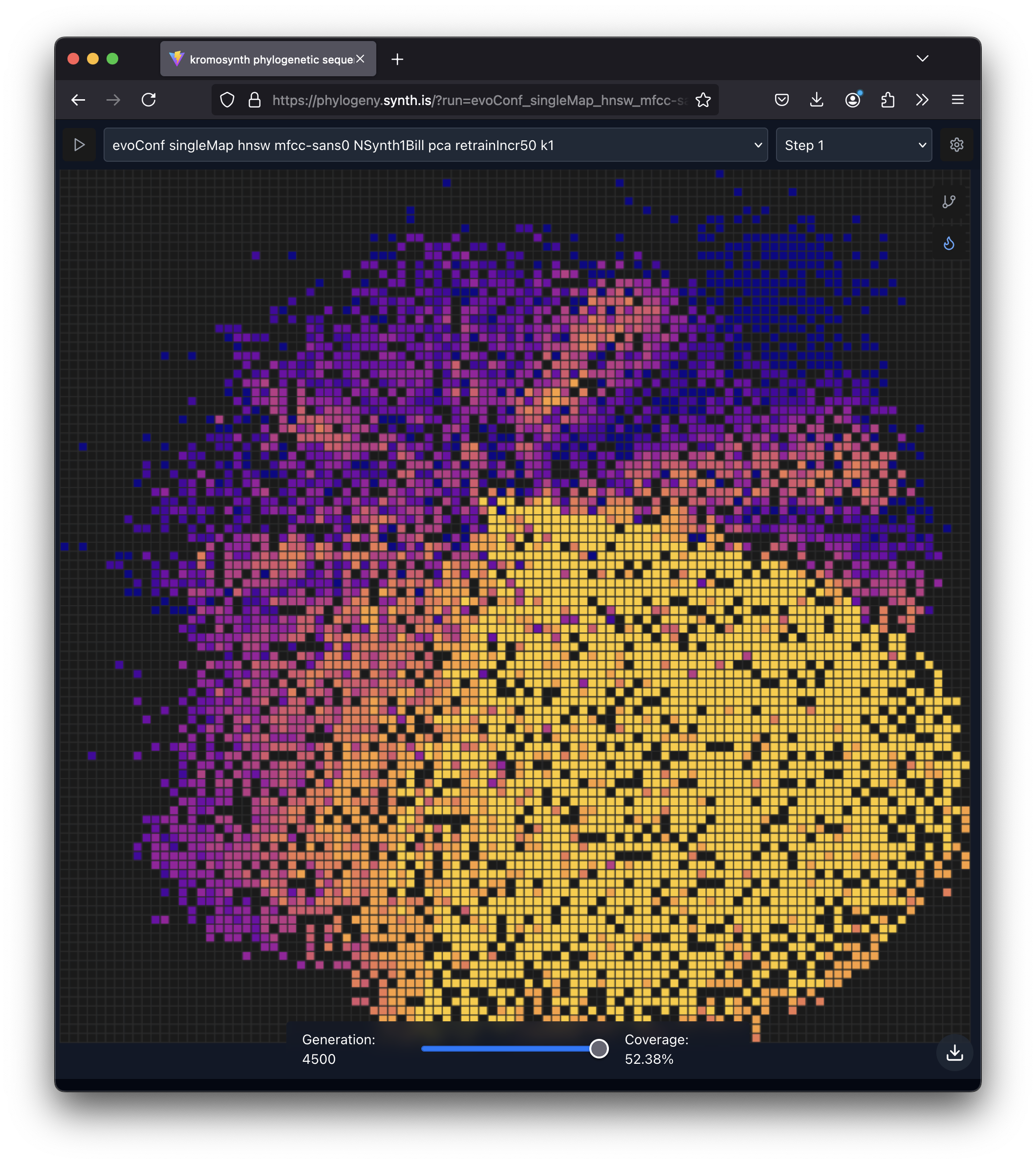
A MAP-Elites archive: each cell represents a niche in the sound space, coloured by quality. The algorithm fills this grid with diverse, high-quality sounds.
Who might find this useful
The people I've spoken with fall into several groups:
Sound designers stuck in repetitive workflows, looking for ways to break patterns.
Film and television composers under deadline pressure who need to differentiate their work and avoid derivative output.
Technical sound explorers interested in collaborative approaches to discovery.
Live performers and researchers who value interactivity and want to see what others are discovering.
What these groups share is an appreciation for sounds that surprise them — sounds they would not have thought to look for.
What's coming soon
I'm building a platform where users can:
Discover sounds through a feed. Browse sounds that have emerged from evolutionary processes, see what others have liked, and save interesting discoveries to a personal collection.

A prototype feed interface: users see sound discovery activity from the network, including likes from other users.
Explore evolutionary lineages. For any sound, you can see how it evolved — its ancestors, siblings, and descendants. This phylogenetic view is optional; casual users can ignore it entirely.
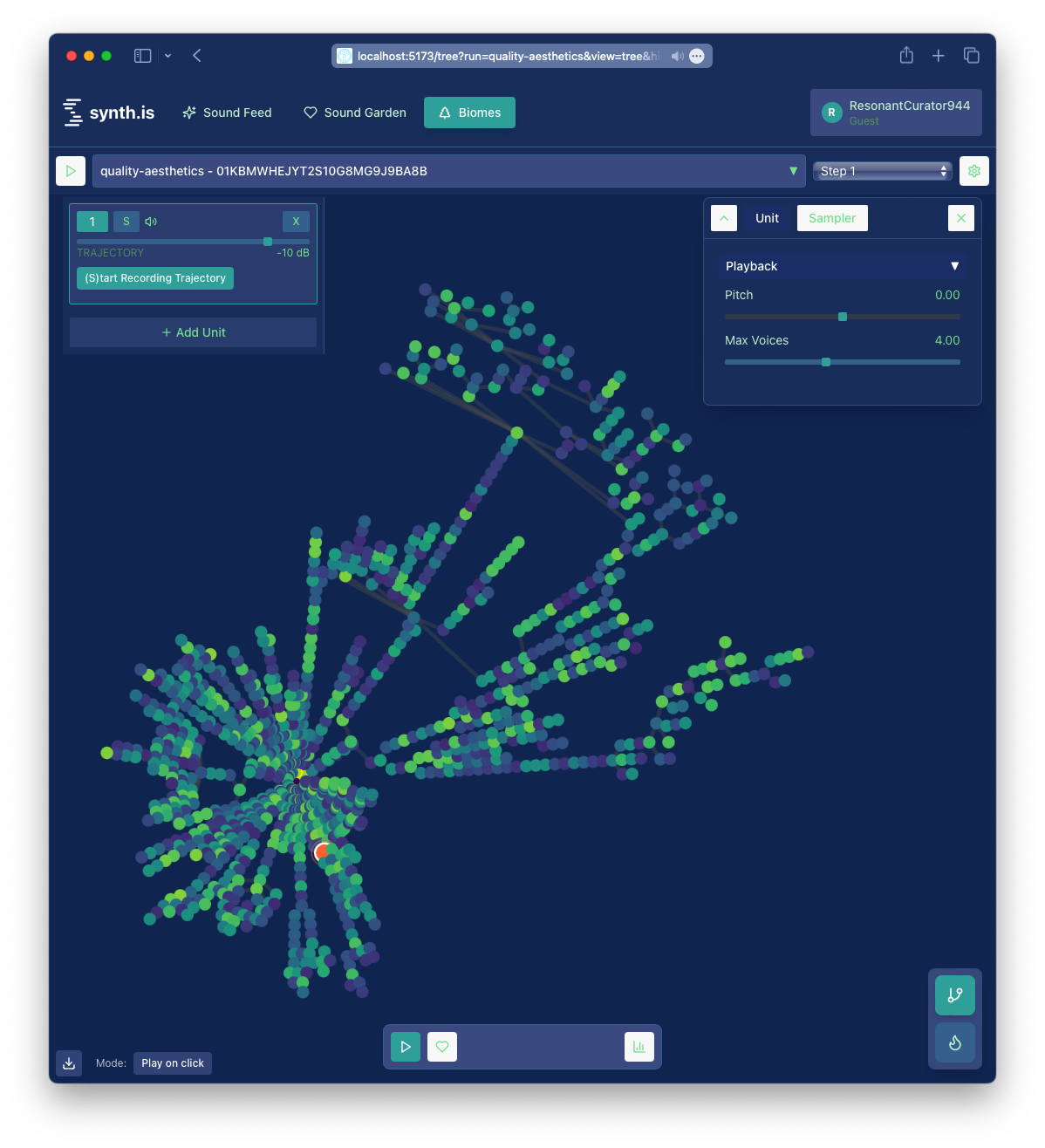
The evolutionary history of a sound, showing how it relates to other discoveries.
Export sounds as virtual instruments. Render evolved sounds into sample-based instruments that load into your DAW.[^3] This bridges the gap between experimental discovery and practical production use.
The core system works. What remains is refinement and finding out whether it's useful to people outside my own research bubble.
What I'm uncertain about
Will the quality be good enough? The system filters out obvious noise, but distinguishing "interestingly weird" from "unpleasantly weird" is subjective. Human curation will likely remain necessary.
Is there actually a market? Producers I've interviewed were enthusiastic, but enthusiasm in conversation does not translate directly to engagement. The only way to find out is to let people try it.
How should discovery work? The phylogenetic trees are intellectually interesting, but a simpler feed-based interface might be what most users actually want. I'm planning to support both and see which gets used.
Try it
I'm looking for people to try an early version. If you work with sound and are interested in exploring genuinely novel sonic material, sign up here and I'll send an invite when the beta is ready.
I've received grants from The Research Council of Norway and the Iceland Technology Development Fund to explore the commercial viability of this technology. For more on the technical approaches and future directions I'm exploring, see the technical deep dive.
[^1]: CPPNs (Compositional Pattern Producing Networks) are neural networks that produce spatial or temporal patterns. Unlike typical audio neural networks, they're not trained on existing sounds — their structure evolves through a process called NEAT (NeuroEvolution of Augmenting Topologies). Technical details: the networks output control signals that drive Web Audio API synthesis graphs, determining how oscillators, filters, and effects behave over time.
[^2]: MAP-Elites maintains a grid of "niches," each representing a different type of sound based on audio features. When a new sound is generated through mutation, the algorithm checks whether it's better than the current occupant of its niche. I'm also exploring more sophisticated approaches: using CLAP embeddings for perceptually meaningful similarity measures, CMA-MAE for more efficient search, and QDHF (Quality Diversity through Human Feedback) to learn what dimensions of variation actually matter to listeners.
[^3]: The virtual instrument pipeline generates SFZ files natively, then uses ConvertWithMoss to produce versions for Ableton, Logic, Kontakt, Decent Sampler, and other formats. This handles velocity layers and pitch sampling to create playable instruments from single evolved sounds.